When considering the Roman Empire (or civilization or culture), Germany isn’t the first place that springs to mind.
Well not for me, at any rate: I mean, Roman… Rome … Italy. That would be my logical progression. However, Trier was the first city (Roman or otherwise) in Germany and the capital of Imperial Rome on the Rhine. Roger has wanted to come here for some time as Trier is famous for its Porta Nigra ( a massive city gate). It became a church due to St Simeon, who took up residence in one of the cells, eventually becoming incorporated into an enormous church dedicated to the Saint.
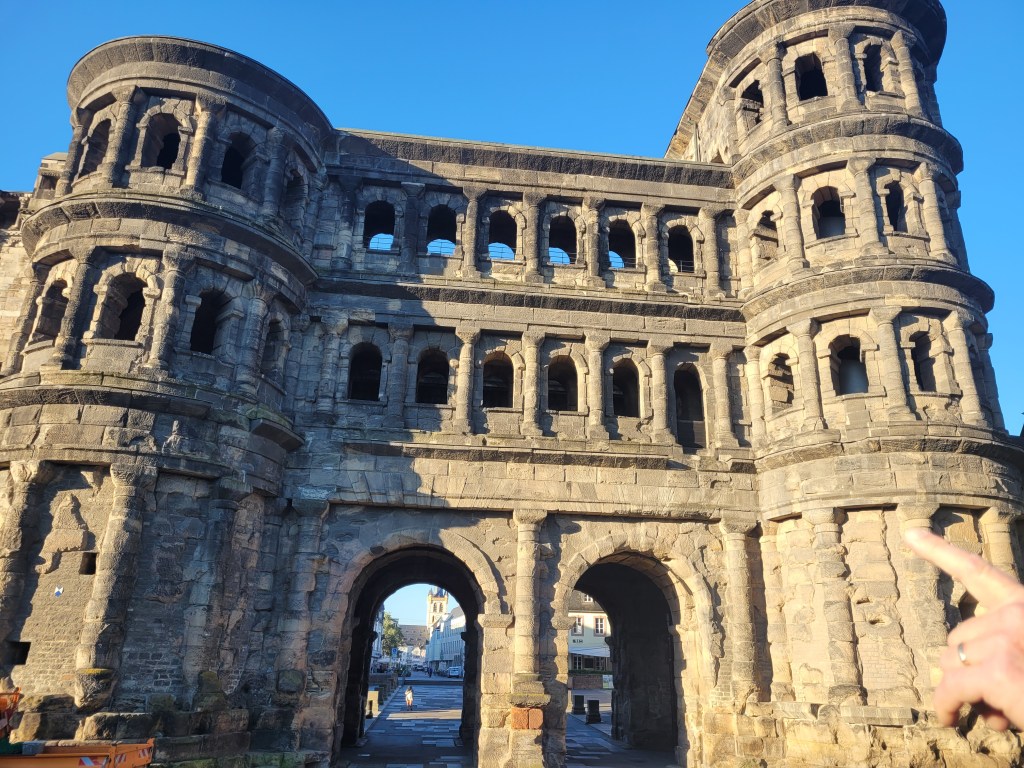
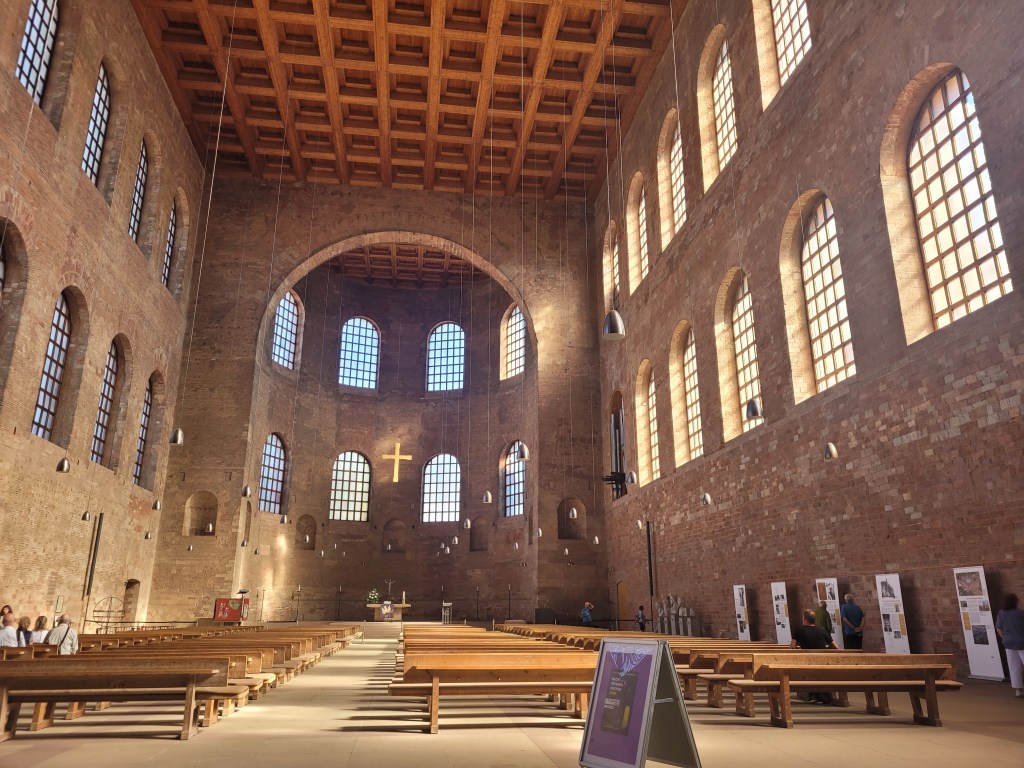
and the Basilica, which is the largest roofed building surviving from the Roman period (although it has been rebuilt, a few times):

Because of his interest, I did know there were some Roman bits and bobs in Trier but I had not expected SO MANY ruins, nor such large ones. And, despite his knowledge and interest, Roger was also a bit taken aback.
The amphitheatre was impressive, built into the hill (as many were) to the extent that before it was ‘discovered’ and excavated in the 19th century, it was used to grow vines.

It also has an underground section, which has been excavated and is open for viewing via the openings in the floor of the arena.

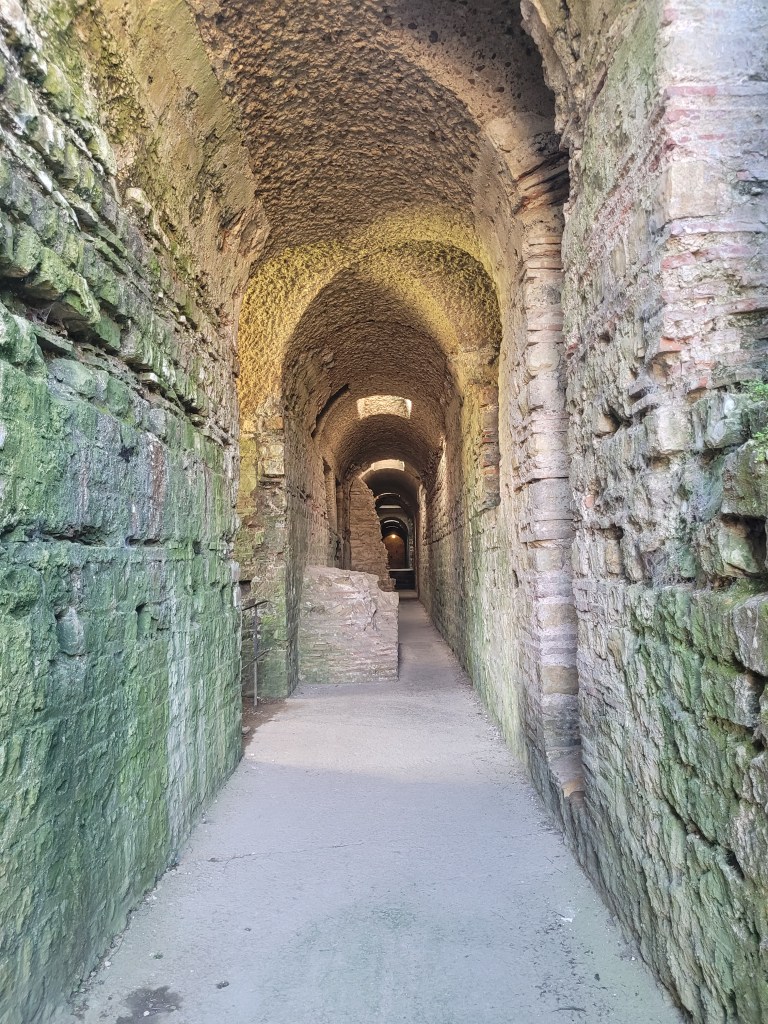
Trier has three sets of baths, all can be visited. The Imperial Baths complex is vast and was never quite completed.

Its underground service tunnels provide welcome relief from the heat but are not for the claustrophobic. It’s a maze and the entrance/exit is unsigned.
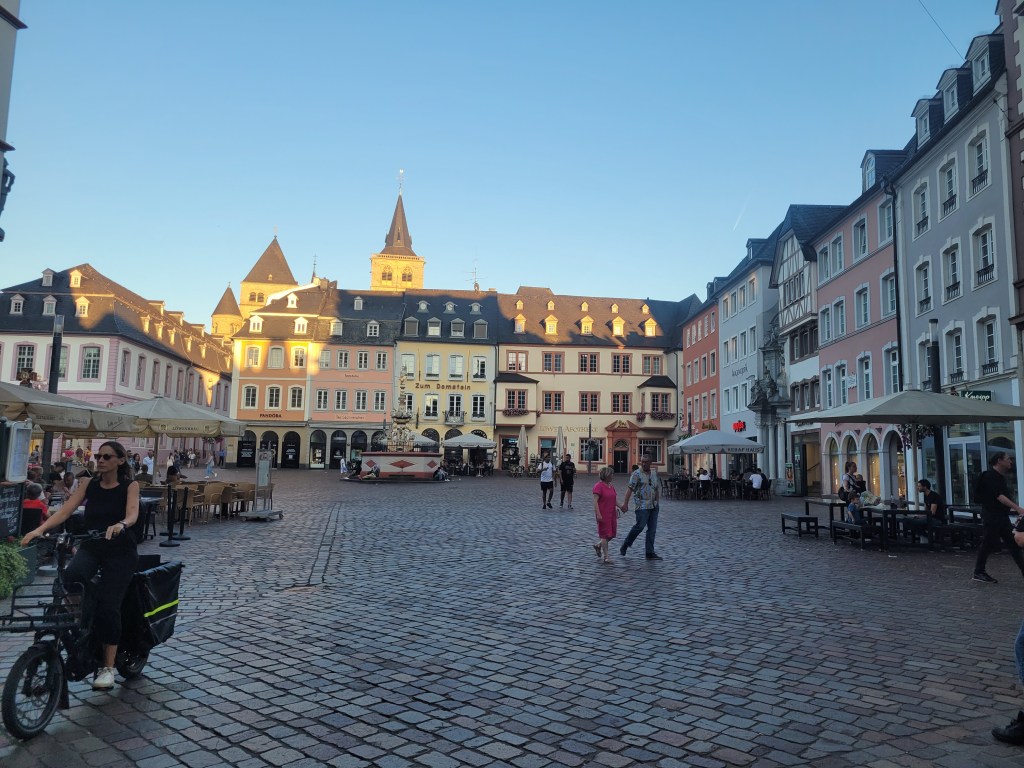
Trier is pretty and mixed in terms of its architecture, with a lovely medieval town centre
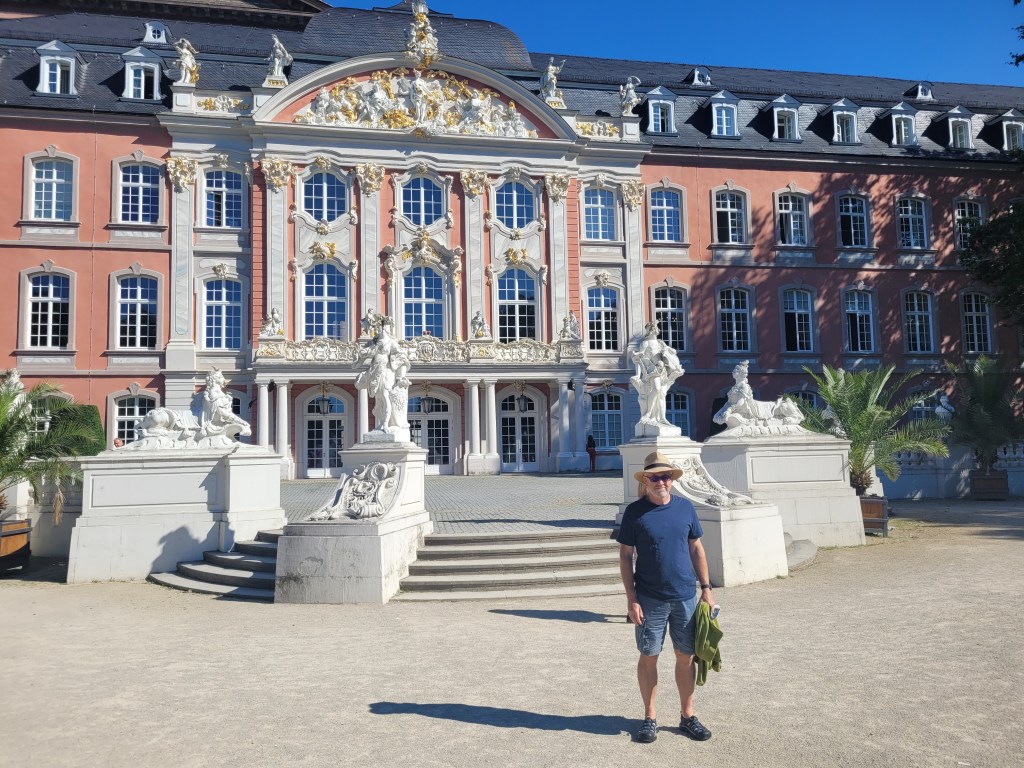
and lots of lovely houses and gardens, but it leans heavily on its Roman past for tourism . Most tourists are German; it has been odd to be somewhere where, despite not understanding the language (at all), we don’t stand out as ‘foreign’. Everyone assumes we are German and speaks accordingly (quickly), ignoring my utter befuddlement.
Other than the unseasonal heat, the food is noteworthy (possibly not for the right reasons). Gut biome beware, this is a cuisine of pork, fried potatoes, pickled [insert vegetable here] and beer/wine. Several of our meals could best be described as ‘solid’ or ‘hearty’ – definitely ‘filling’. Fine, but I doubt German cuisine will feature much at home.
There are a LOT of churches in Trier – we peeked into four but there are many, many more. The Catholic cathedral is interesting as the central core was built during the late Roman period (the Roman bricks are clearly visible); a wasps’ nest of gilded, ornate organ pipes dangles in one arch. The myth is that it was built around an earlier, fourth century church gifted by St Helena, mother of Constantine.

The Basilica, however, was the most poignant for me. After centuries of adaptation, re-imagining and reconstruction, the building was destroyed in a WW2 bombing raid. The congregation understood this as a judgement on their refusal to condemn Nazi actions and took the decision to return the Basilica to its earliest, Roman, form. It is a quiet, reflective space, with a stark simplicity belied by its sheer bulk.
The town is easily encompassable on foot, with some lovely green spaces. On the outskirts of town, by the amphitheatre, across the river, everywhere, there are vines. Even vines trained as ornamental trees

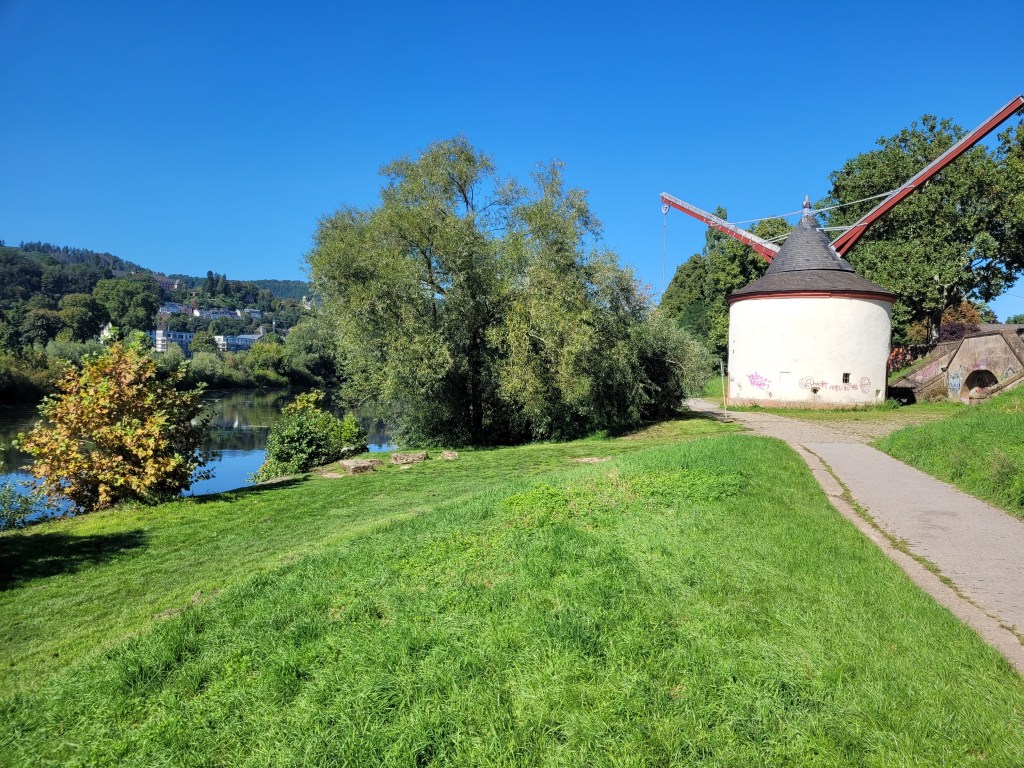
Our final Roman experience in Trier was the modern bridge across The Moselle, which rests on Roman piers. Along the river bank, cranes are testament to the importance of the river as a means of transport.
What we have learned is that if you want your Classical building to survive, it needs to be repurposed as a church!
Trier: Pretty, vines, fairly prosperous, popular with domestic tourists, Roman.
Coming up, more trains.
 Retired? What now?
Leave a comment