If I think about ‘Italy’, I somehow automatically think of a Southern country. Yet using Google maps to locate us, I realised just how far north we really are. This despite all the travel time from Tirano to Verona: really we just did a sideways U shape, going mostly east to Milano (with a bit of south) and then west to Verona (with a bit more south but not much).
The result is that we remain, very much, in Northern Italy and shockingly close to the border with Switzerland (and Austria). Culturally we are very much in Italy, however.
The ride from Verona to Bologna took just over an hour on a high speed Frecciarossa (that had very dirty windows – it’s not just my poor photography). It’s flat, with fields all the way punctuated by the odd irrigation canal or river. We rushed past polytunnels (vines, I think), more vines with netting (maybe fruit trees?), more vines (netting rolled back), just vines… It went on and on.
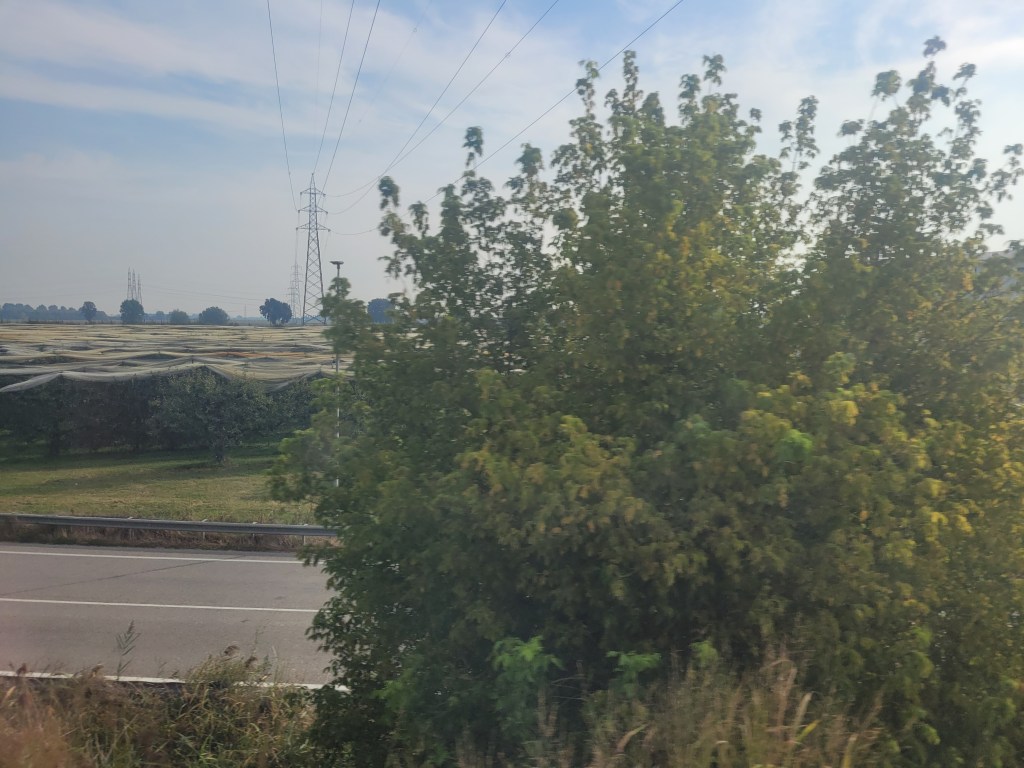
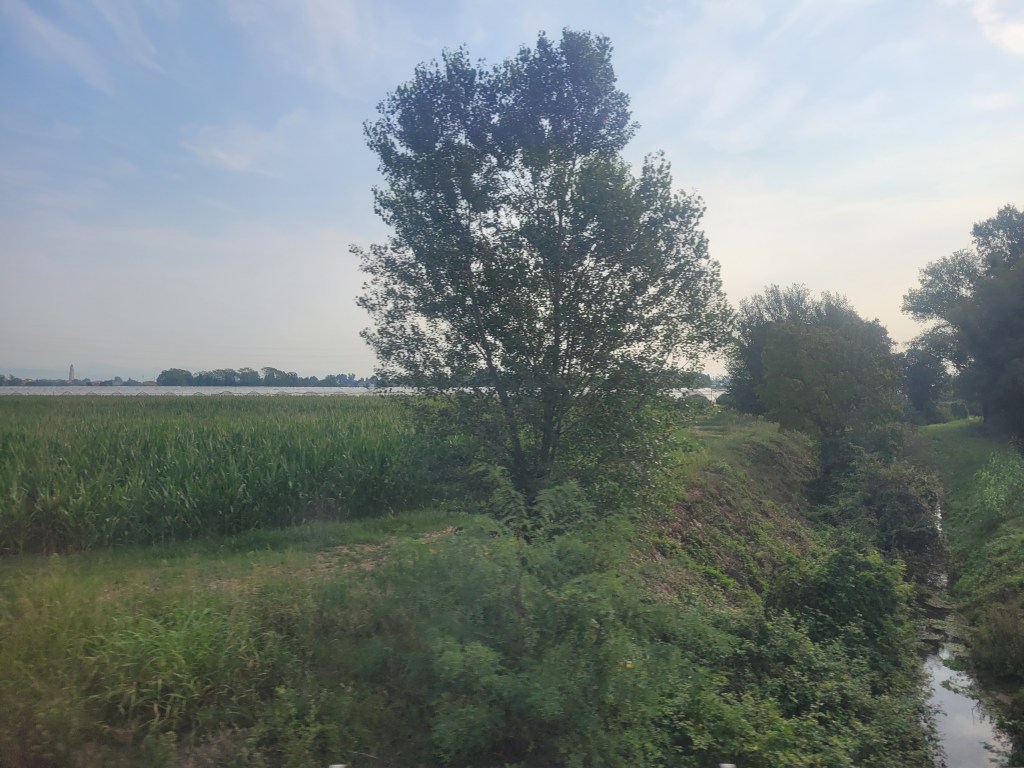
Then it changed to enormous fields of wheat, something very green and low growing (but not a leafy vegetable), maize, harvested fields full of stubble and empty, plowed fields – but the train was moving so fast it’s almost impossible to be sure about what is growing where. That it’s flat and commercially agricultural was indisputable, however.
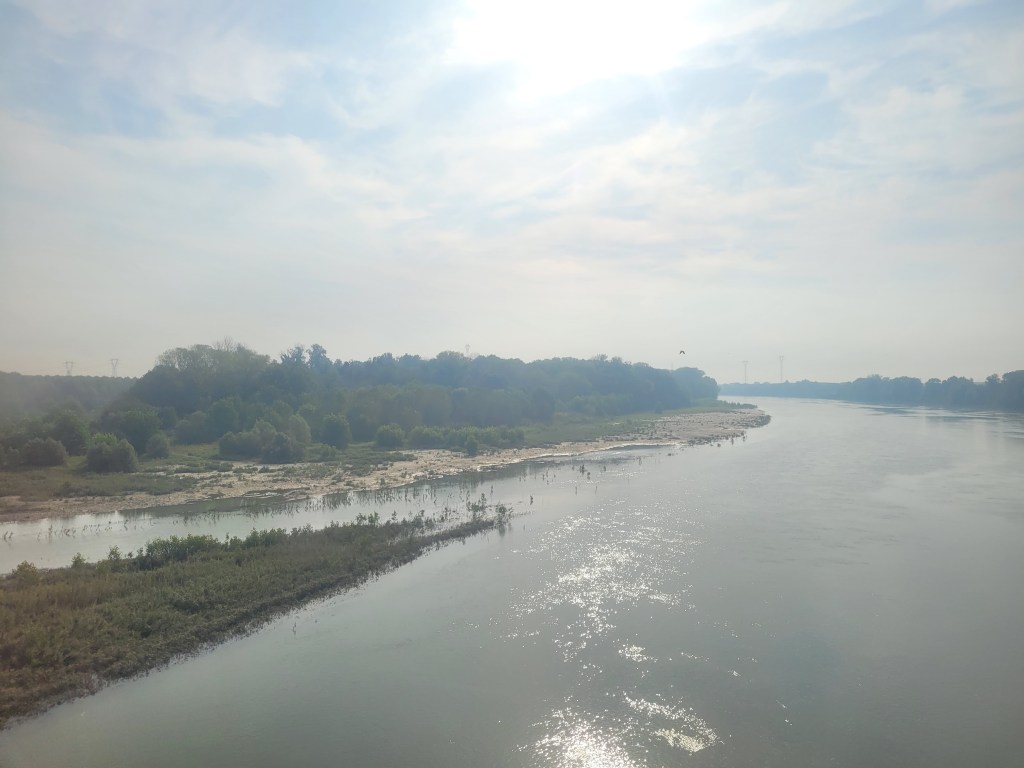
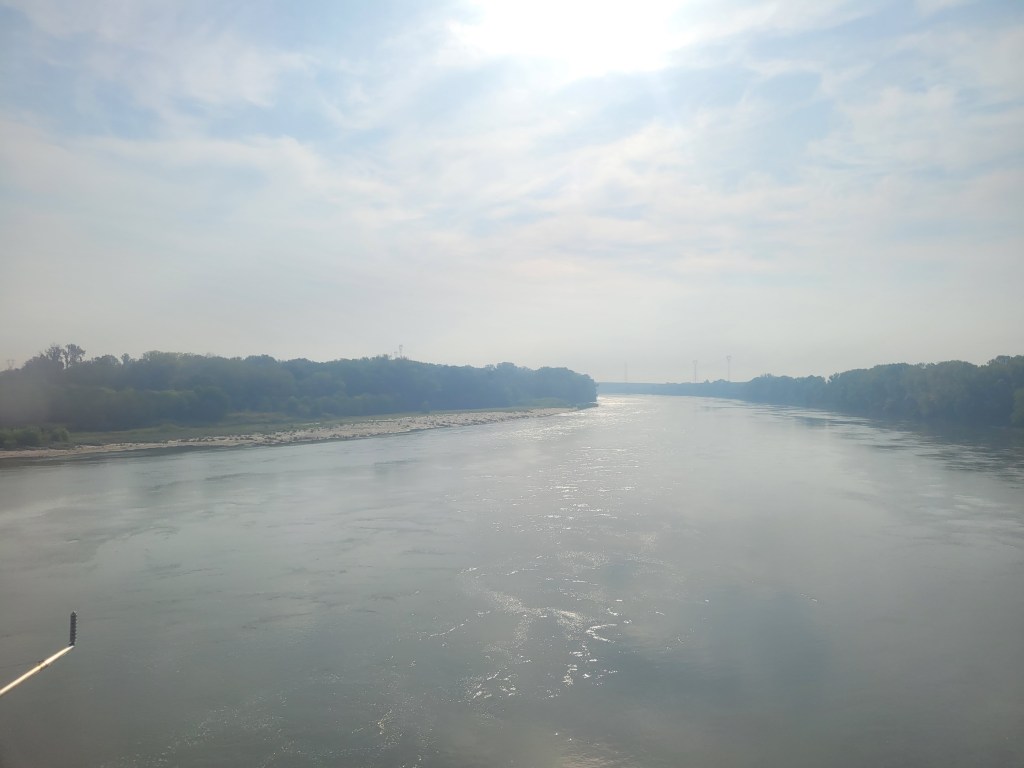
The Po river was crossed at speed and it was sheer dumb luck that I caught a few pictures:
And we got to Bologna.
The station is massive and complex; our train arrived underground but our departure platform was in a completely different part of the station, several floors up. At one point we walked as briskly as possible through a carpark (no, not lost, just following the yellow line to ‘Binari 1-11’). We hadn’t accounted for this: maybe it was a mistake to think we could do this transfer in 20 minutes.
But we arrived on platform 9 in a timely fashion (JIT, to be honest), boarded the train and departed.
Once out of Bologna (a matter of minutes) and its industrial surround (a bit longer) the train ran through more agricultural land: vines, fruit trees, some maize and mostly empty fields that had already been harvested. Here, however, the fields were significantly smaller. There were also a few hills towards the south so it was slightly less repetitive (and the windows were cleaner).

In places the vines appeared tangled and overgrown, and I saw something being trained up lines of wires. Vines? Who knows. We were too far away and going too fast. There was also one field of olive trees. Just the one.
And then it was mostly vines, with some fruit trees. And they were definitely all on wires, some rows higher than others, some rows more three-dimensional than others. This might account for that ‘overgrown and tangled’ look.
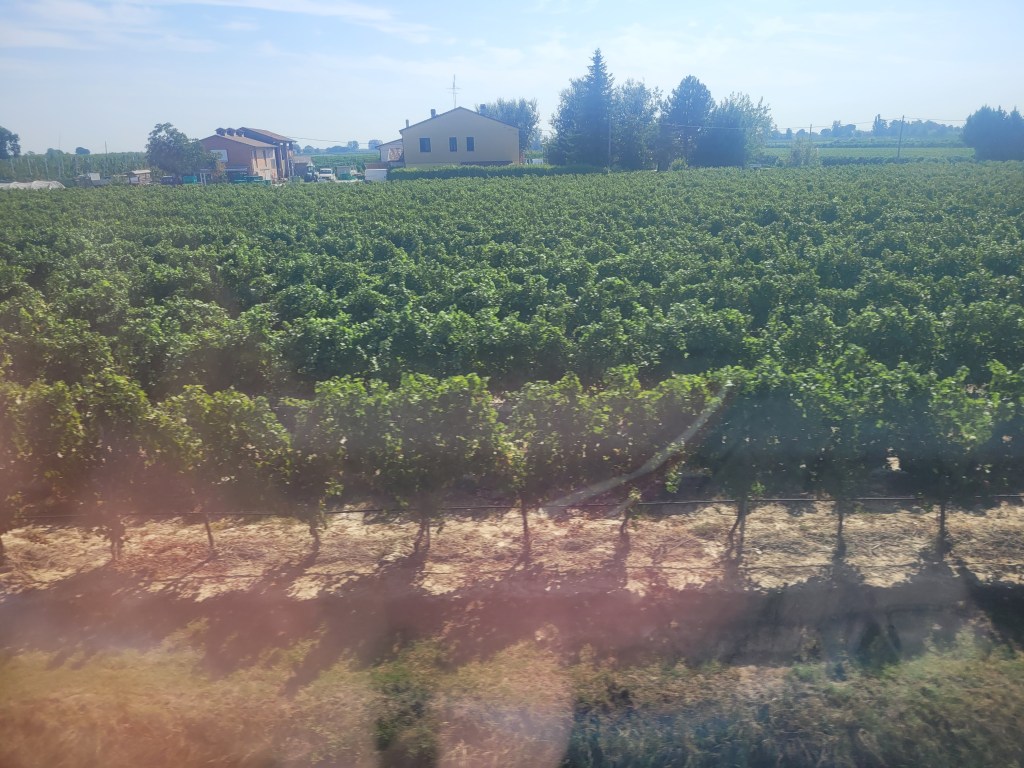
In the distance, among a larger stretch of vines, a cluster of storage tanks reared up. We are in Emilia-Romagna after all, where they have found the remains of Etruscan wine making.
The train station at Ravenna is small (a relief) and we wandered out into the heat wondering how Ravenna would compare to Verona.
Superficially, it doesn’t. Walking away from the station, we both commented on the mid-20th century style of building – it’s a bit soul-less and rather unattractive. The main square is pretty but small – the whole town is actually quite small. Within the historical centre many of the side streets are cobbled, which led to a revisiting of the backpack versus wheelie bag controversy: the backpack won this time. Dragging a bag over the fairly rough cobbles proved tiring and tricky – thank goodness it’s a two-wheeled bag, a four wheeled one would have been impossible.
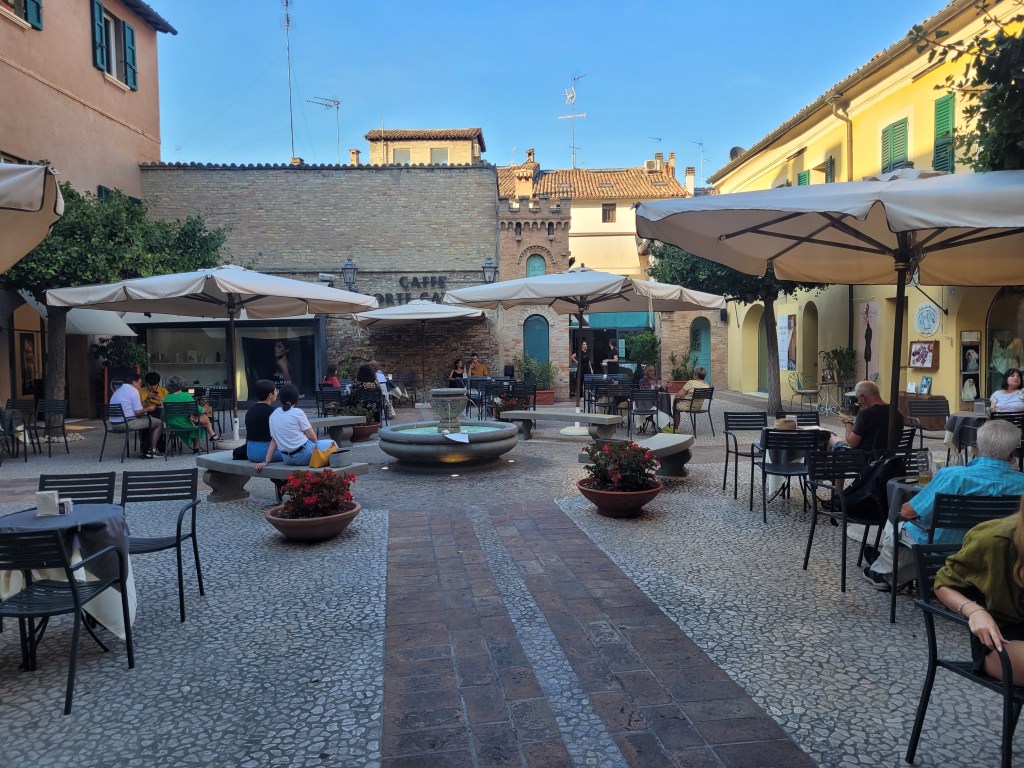
So far, Ravenna has felt smaller and less moneyed than Verona but there also appeared to be fewer tourists – and fewer crowds generally. We found a nice places to sit where I had my first Aperol Spritz of the journey.
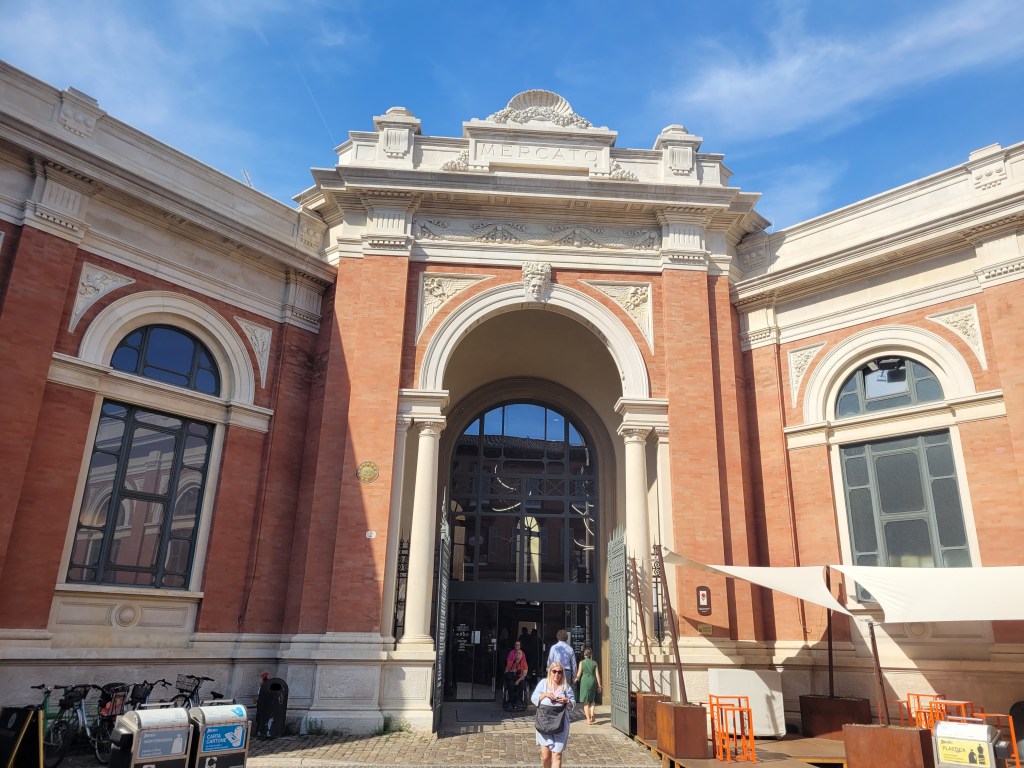
And a covered market where we had an enormous, delicious Florentine steak (and red wine).
In Verona, when I tried to use my – albeit limited – Italian, people got impatient and just spoke English. I understand why, it was super busy and they didn’t want to take the time. In Ravenna, people do slow down, they wait for me to stumble through my sentences and they correct me, gently, to make it clearer. This may be solely a reflection on a smaller place that is a bit off the beaten track, it may also be because I am not part of a big tour on a day trip and it could also be that I am willing to have a bash at the language and (quite desperately) want to improve. Either way, everyone has been nice.
Ravenna is a fascinating place historically: it became the Imperial capital in the late Roman Empire when Milan became too dangerous (early 400s); with the fall of the Western Roman Empire it became Theodoric the Great’s capital (an Ostro-Gothic King and an Arian Christian); it has some important early Christian artwork (and I mean EARLY) that has survived the vagaries of history.
And that’s what we are here to see, the red wine and steak are purely incidental!
Mosaics tomorrow.
 Retired? What now?
Leave a comment