On our last full day we moved northwards, towards the more well-known (to English tourists at least) towns of Ostuni and Martina Franca.
Crossing from Gallipoli to Brindisi, the countryside was flat (no surprises there), rocky and barren; fields of vines and olives gradually started to appear as we moved eastwards. All the olives were young – small trees that looked as though they had not quite reached the productive stage. We headed towards Ostuni, one of the famous ‘white towns’ of this part of Puglia.
Perched on a hill-top behind the coast, Ostuni is, indeed, white.

From the terraces you can see the Adriatic.
Like parts of Gallipoli and Otranto, Ostuni is a tight maze of tiny streets, confusing in their windings and dead-ends. There are a lot (and I mean A LOT) of tourists: in large groups, in small groups, in couples. They were everywhere. And there are a lot of hotel rooms. The hotels seem to be dispersed, not in one single building. A lot of the doors on some streets opened into hotel rooms, complete with piles of bedding and towels waiting to be laundered. The wedding in the cathedral added to the confusion and volume of bodies, at times it was almost impossible to get through the crowds.
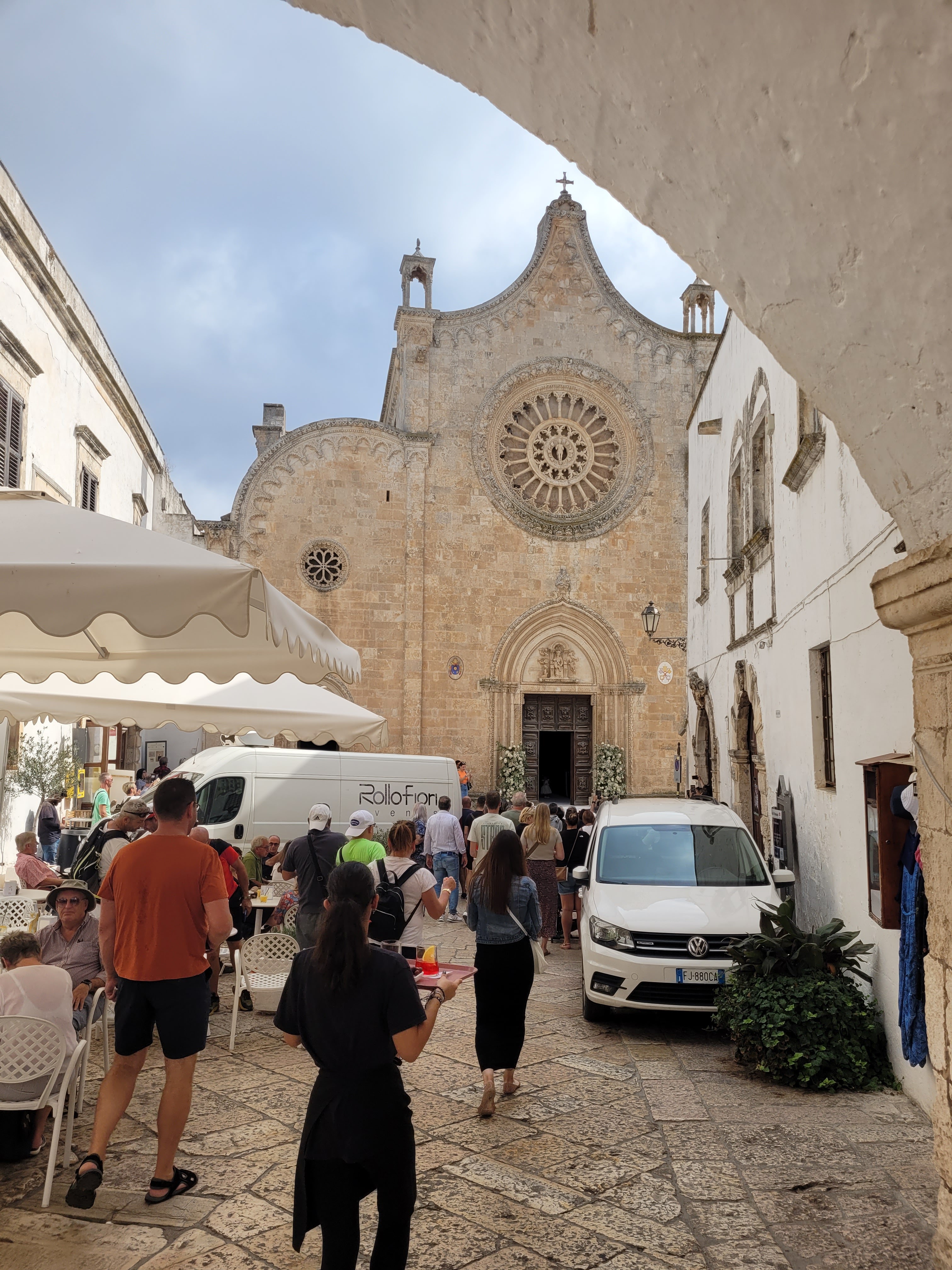
Having paid for a day’s parking in a lot run by an enterprising group of elderly men (they were wearing high-vis jackets, but somehow I doubt it was an official car-park), we spent less than two hours in Ostuni. While pretty, it was all too much – and we both doubted that anyone actually lived in the town itself.
Martina Franca, in contrast, was lovely and felt like a normal, real place, with actual locals having lunch, or going about their routine business. That could be because the centre of town was a challenge to find (the outer doughnut of the town is less impressive) and therefore when we stumbled upon it (quite by accident) we were so relieved that anything would have seemed wonderful!
Martina Franca is larger than Ostuni, the second largest town in this area after Taranto (on the coast). It is west enough from Ostuni that, when you do see the sea, it’s the Ionian coast you catch odd glimpses of (out of town).
It was walled (like Ostuni) but these aren’t very apparent any more other than the (very few) ornate gateways into the old town.
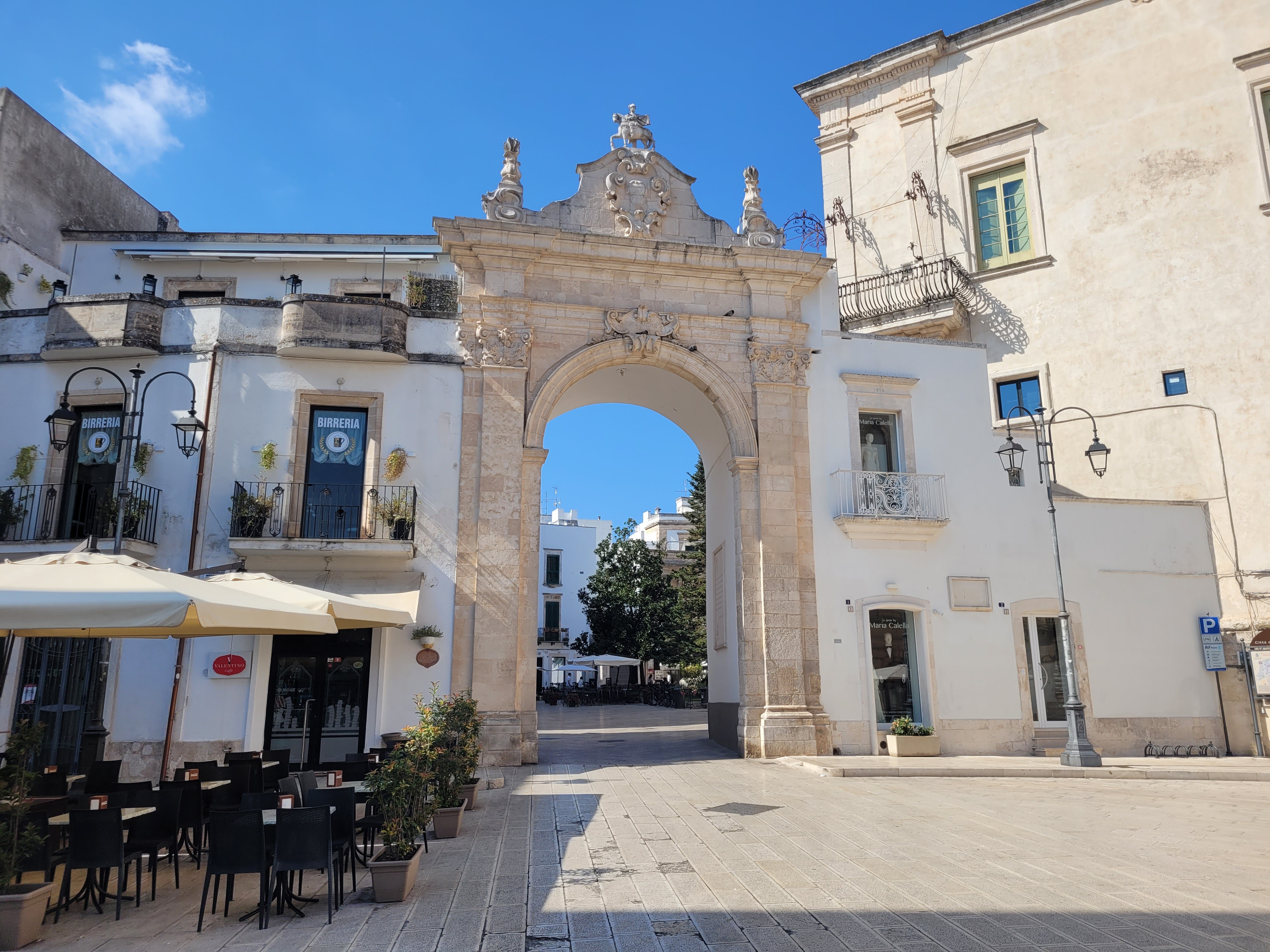
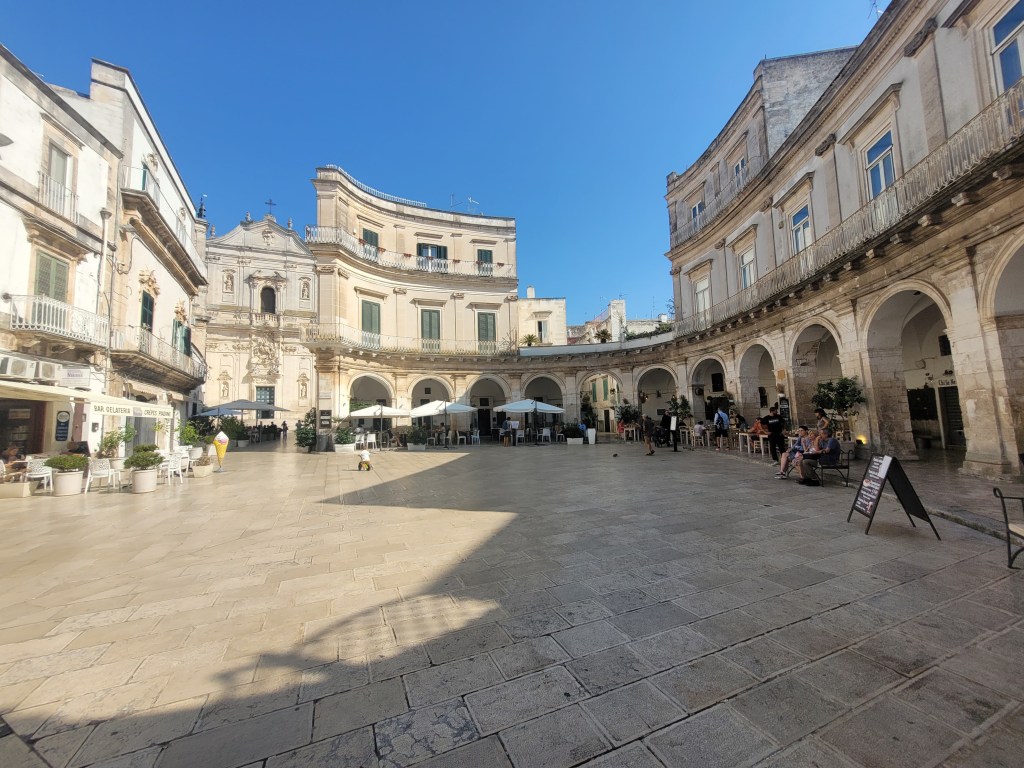
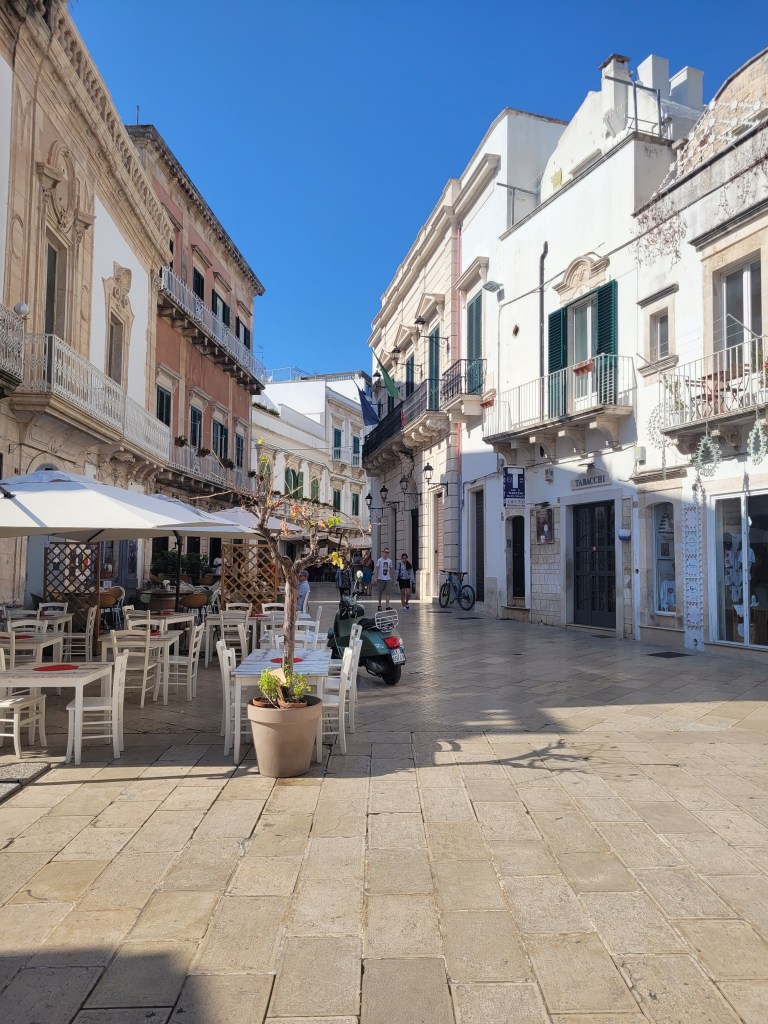
The centre is pedestrianised (all this means is that there are fewer cars, not an absence of them), with some lovely squares and a pretty cathedral. Well worth the navigational challenges to visit – and possibly even to stay.

In this part of Puglia, vines and olives (surprise!) dominate. Not having been as affected by Xylella, the olives are older, with twisted, gnarled and sometimes hollow trunks. Mostly there is a semblance of rows or ranks but sometimes they just seem to be in random groves.

The road across the hills, west from Ostuni, runs through a pine forest, the dark greens bright against the blue sky, with pines giving way to vines, more vines and even more vines. As you come out of the hills and onto the coastal plains, olives take over.
This part of the countryside looked more affluent, better kept, more valued. That’s the upside – the downside is more tourists, although efforts have been made to keep the tourist development low key (yes, lots of Trulli houses – no, I didn’t take any pictures).
And the next day we flew back to the UK, this particular Italian adventure at an end.
 Retired? What now?
Leave a comment